The Rise of Fintech in MCA: A New Playbook for Brokers & ISOsPart 1: How the MCA Market Forever Changed
Fintech is invoking the greatest structural change we've seen in MCA. The way merchants find and accept capital is changing, and fintech platforms have reset the market around embedded distribution, live data, and faster borrower expectations.
In our next 3-part series, we will take a data-driven approach to exploring the rise of fintech in MCA, and the implications for brokers and ISOs. Part 1 will examine the structural changes in the market, and Part 2 and 3 will outline the core differences and gaps between fintechs and traditional broker solutions, and the required adjustments that brokers & ISOs need to make to stay competitive.
This is Part 1: How the MCA Market Forever Changed.
MCA is a growing market, and it is not even close.
First, let's establish some known truths: the MCA market is a massively growing industry.
We broke down the data in our last post: Is MCA Dead? Here's What the Data Tells Us.
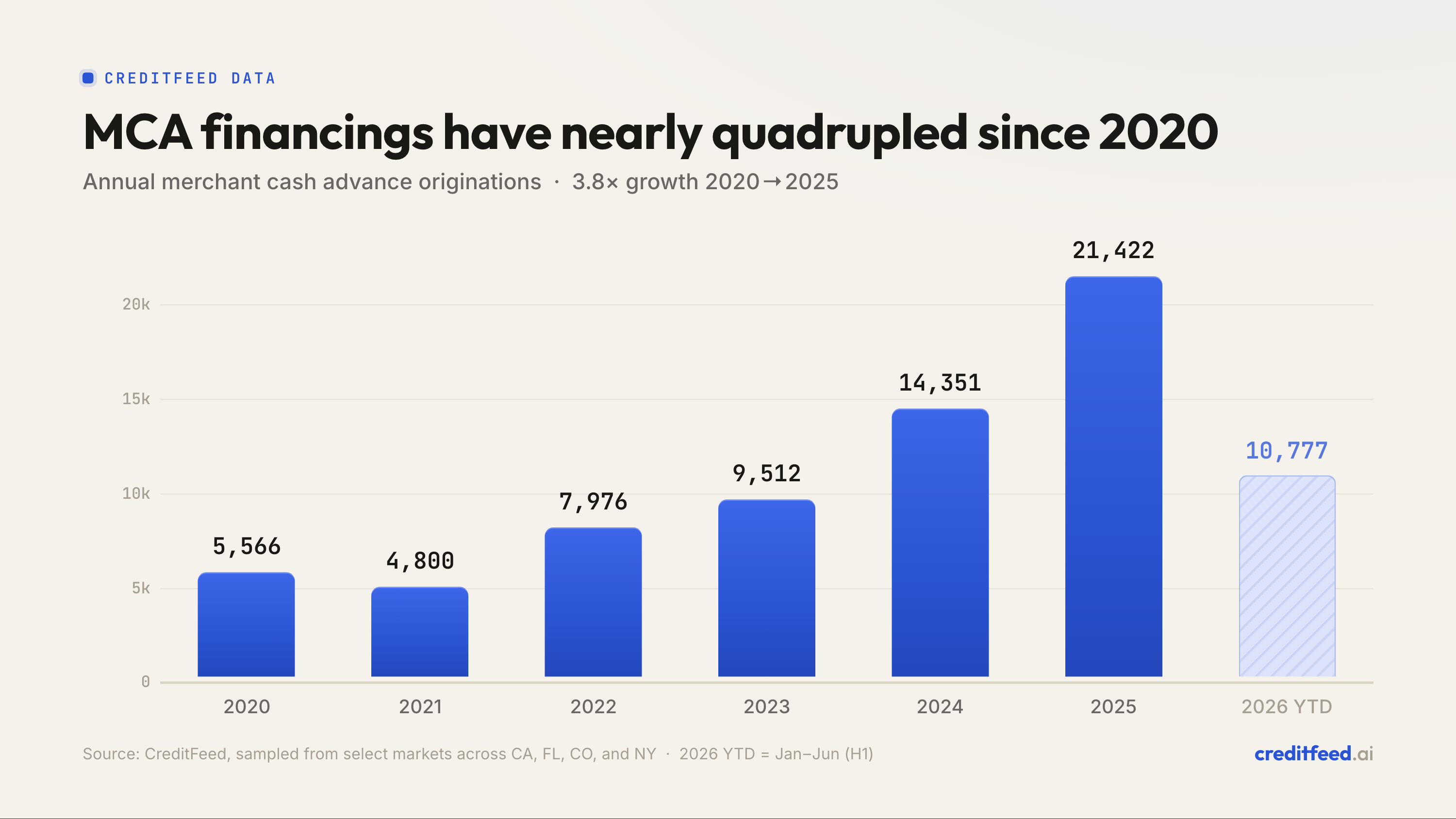
Across the markets we sample, annual MCA financings have nearly quadrupled since 2020. More merchants are entering the funded pool, and lenders are writing more deals.
But growth is only half the story.
The more important shift is how merchants are getting access to capital. For years, MCA was mainly a broker-led market: a merchant needed working capital, an ISO or broker collected bank statements, packaged the file, shopped it across funders, and pushed the deal through. That model still exists today.
But the way merchants receive MCA capital is now going through the biggest structural shift in the product's history, driven by the rise of fintech platforms.
The Rise of Fintech in MCA
A growing share of MCA financings are no longer originated through brokers and ISOs. They are originated through fintech platforms like Square, Shopify, PayPal, Toast, and Clover. The numbers are no longer theoretical. They point to a fundamental change in how capital reaches merchants.
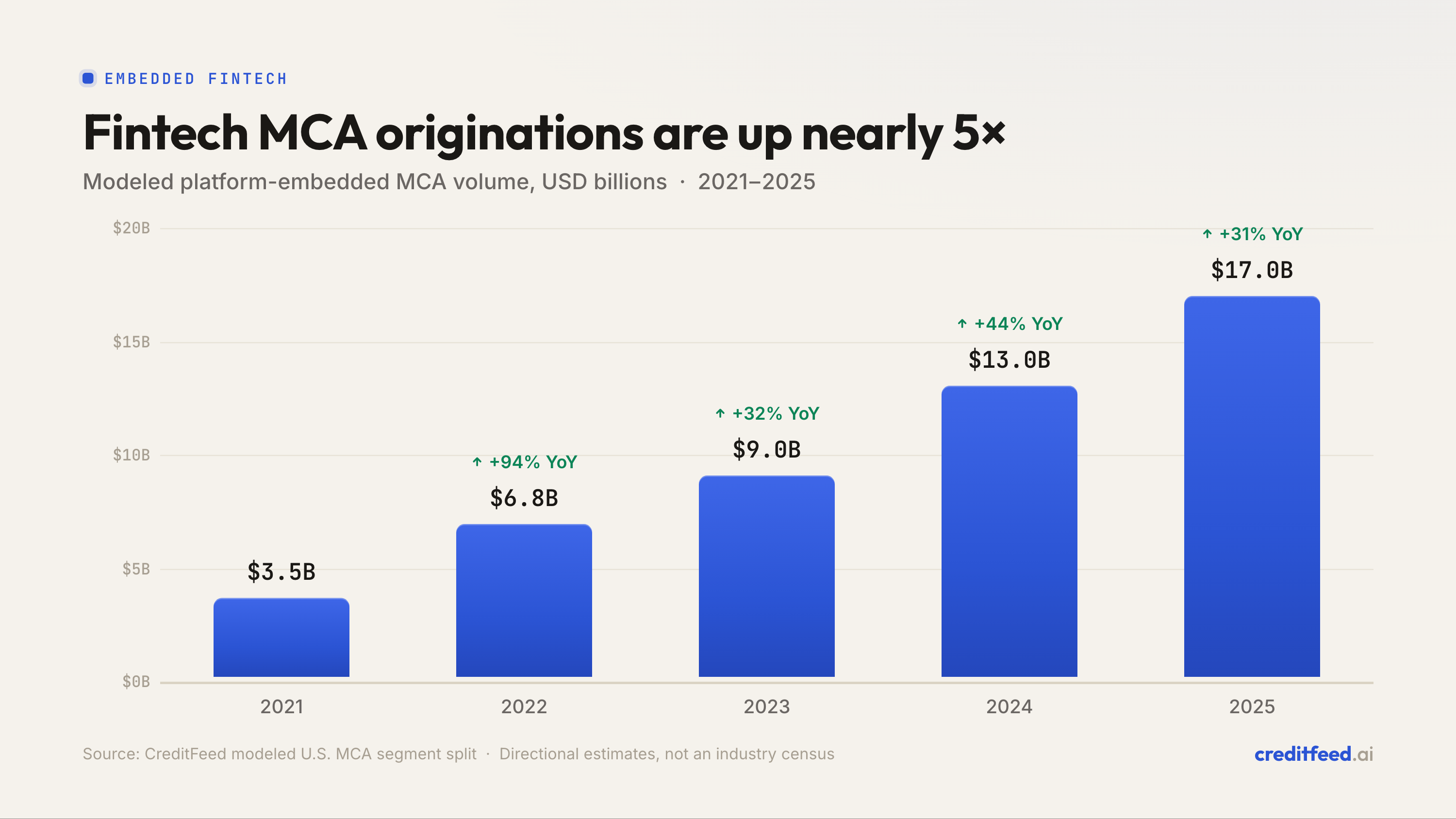
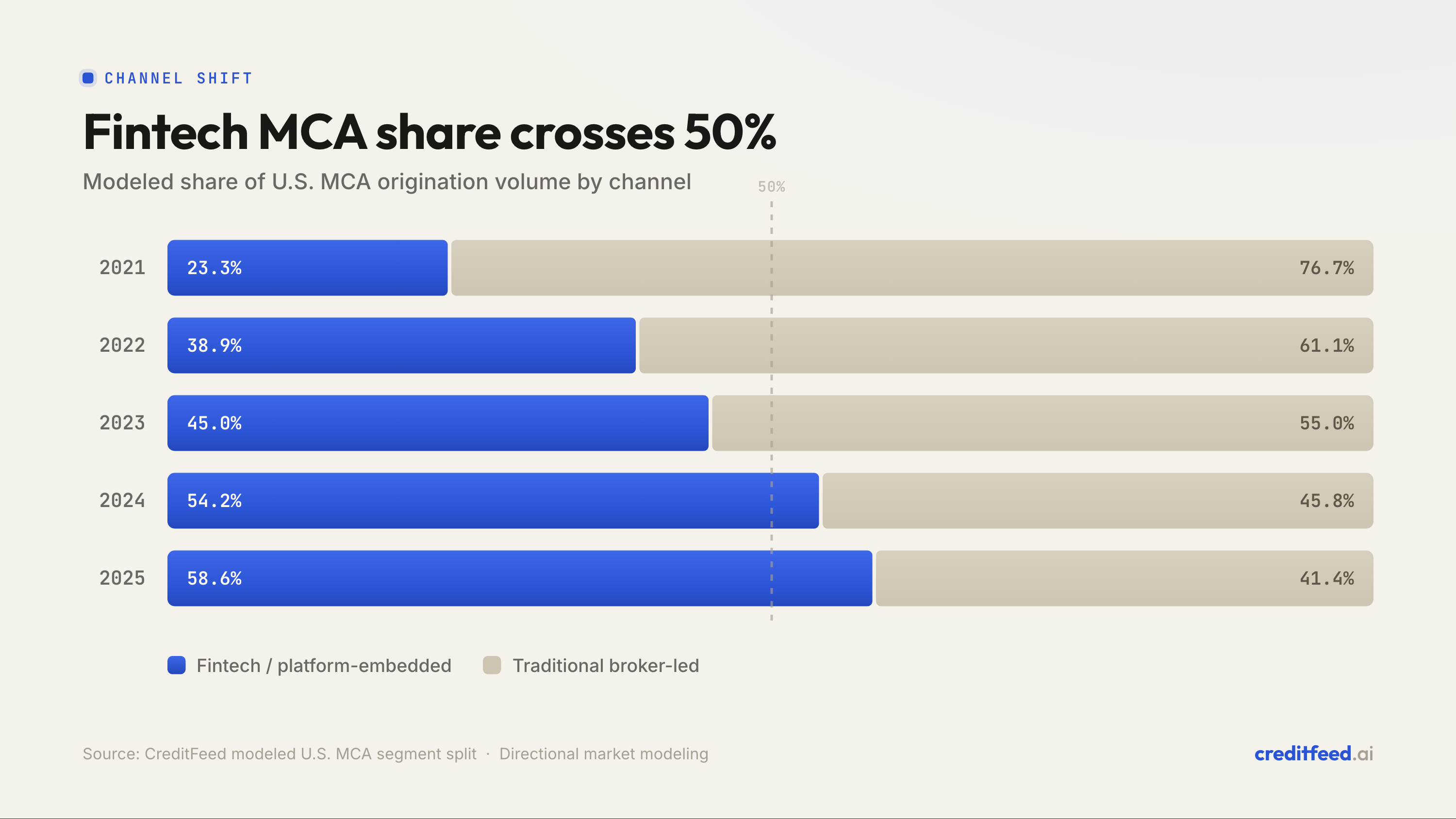
Note: the two charts above use the modeled U.S. MCA origination split from our fintech research file, which counts platform-embedded advances and revenue-based loans. Treat the fintech-vs-traditional share as directional market modeling rather than a definitive industry census.
Other industry reporting corroborates the magnitude of fintech's impact on MCA origination:
Square Loans originated $5.7 billion in business loans in 2024, according to deBanked. Square has also said it has originated more than $32 billion in small-business loans since 2014.
Shopify's 2025 Form 10-K reported that the company purchased $4.2 billion of merchant cash advances and loans to Shopify merchants in 2025, up from $3.0 billion in 2024.
Toast said in its 2024 prepared remarks that Toast Capital originations exceeded $1 billion for the year, reflecting strong demand from restaurant customers.
These are not fringe programs. They are large, repeatable funding channels sitting inside operating platforms merchants already depend on.
That is the first major lesson for brokers: the competitive set has changed. The merchant is not only comparing one broker against another broker. They are comparing the broker experience against the financing experience they get from the tools they already use.
Fintech did not invent MCA. It changed where MCA happens.
Traditional MCA starts outside the merchant's operating system. A broker reaches out. A merchant uploads documents. A funder reviews the file. The repayment gets set up through ACH or card split. The process may be fast compared with a bank loan, but it still feels like a financing process.
Embedded fintech works differently.
The capital offer appears inside the software the merchant already uses to run the business. A Shopify seller sees funding in the Shopify admin. A Square seller sees loan options in the Square Dashboard. A restaurant using Toast can access Toast Capital from inside the same ecosystem that processes orders and payments.
That placement changes the psychology of the product.
The merchant is not starting a search for capital. The platform is surfacing capital at the moment it believes the merchant is eligible.
That is a major advantage. The platform already owns the merchant relationship, the payment data, and the daily workflow. It does not need to buy a stale lead list, cold call the owner, or convince the merchant to trust a new finance brand. It can put a prequalified offer in front of the merchant where the merchant already works.
That is why fintech MCA is not just a product story. It is a channel story.
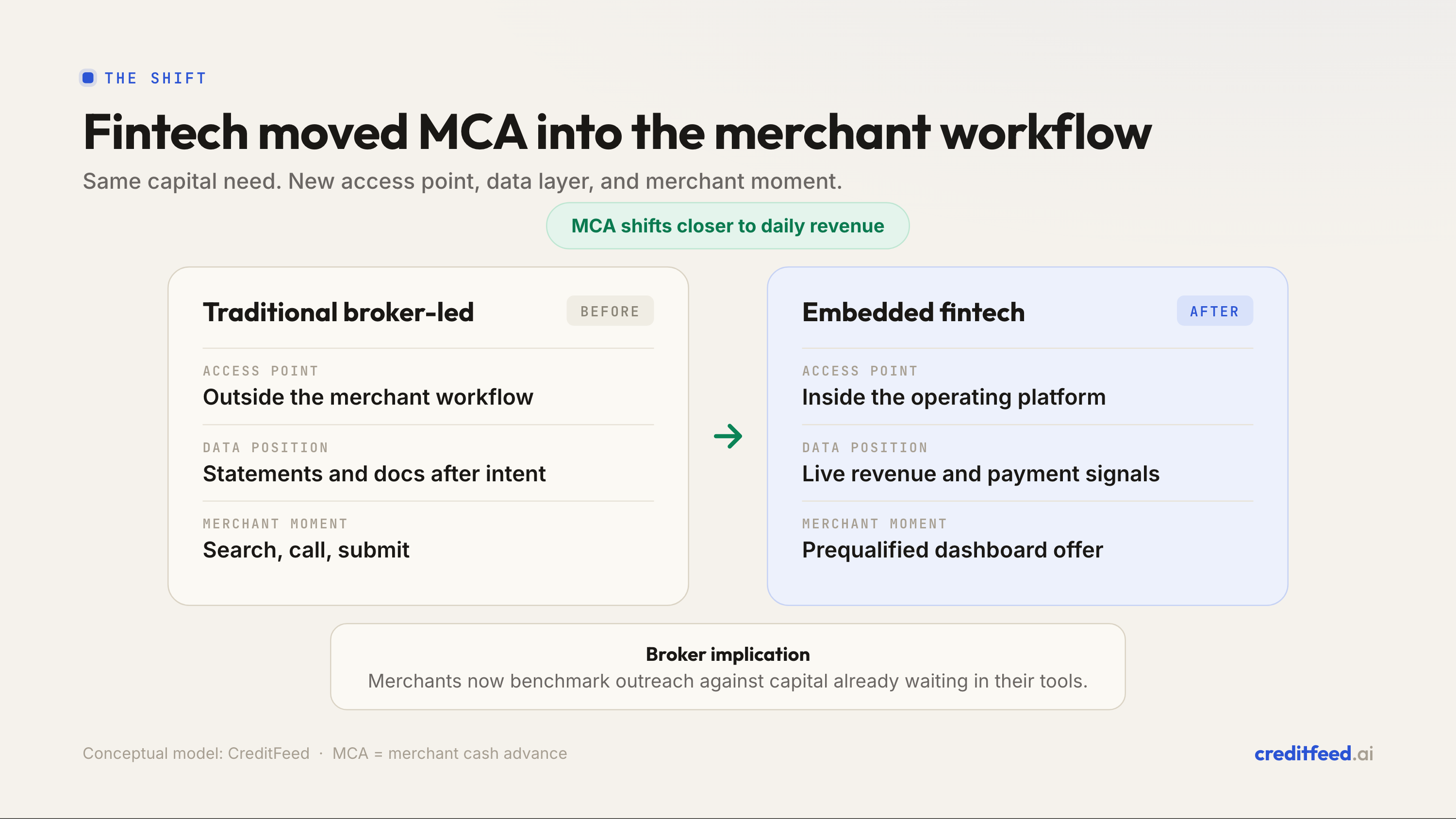
The underwriting and the experience changed too.
Fintech did not only change where MCA happens. Brokers underwrite from historical documents pulled together after a merchant engages. Platforms underwrite from live payment data they already hold, so an offer can appear the moment a merchant qualifies. Fintech underwriting is not always better, but it is immediate, and that reset what borrowers expect: less paperwork, faster answers, pricing shown as a simple payback, and repayment that flexes with sales.
That convenience has a cost. Embedded offers can be take-it-or-leave-it, lock a merchant into one processor, and reject anyone who does not fit the algorithm with no human to make the case. Those limits are exactly where brokers still matter.
The market is growing. The question is who captures it.
The MCA market is still expanding, which is good news for brokers and ISOs. But a growing market does not mean brokers automatically capture the growth. Platforms sit on the merchant's daily revenue data, so they identify eligibility and fund inside the workflow before a broker ever gets a shot.
The broker's old edge was access. That is no longer enough. The new edge is timing, intelligence, and fit: which merchants are newly funded, which are nearing a renewal, which are stacking or showing fresh funding intent, and which deals are worth a call today rather than six months late.
Fintech is not replacing brokers. It serves clean-fit merchants well, but MCA has always had a long tail of complexity that platforms cannot size or structure. That is where brokers win, if they stop relying on generic lead lists and stale data and start working the seams the platforms leave open.
Here is the reason for optimism. MCA financings have nearly quadrupled since 2020. Even with fintech platforms now taking roughly half of them, the half that remains is far larger than the entire market was a few years ago. The pie grew faster than fintech took share. That leaves more volume, more renewals, and more complex deals in play than ever, and plenty of room for brokers and ISOs to stay highly competitive.
That is the setup for the rest of this series.
Part 1 mapped the market shift: fintech moved MCA into the merchant's daily operating system.
Part 2 goes deep on the differences. How a fintech-led financing actually compares to a broker-led one across distribution, underwriting, pricing, repayment, and flexibility, and exactly where the gaps are that embedded platforms cannot close.
Part 3 turns those gaps into a playbook. How brokers and ISOs can use the changing dynamics to their advantage and win more deals, without trying to become Shopify, Square, or PayPal.
The next two parts are about where the openings are, and how to work them.