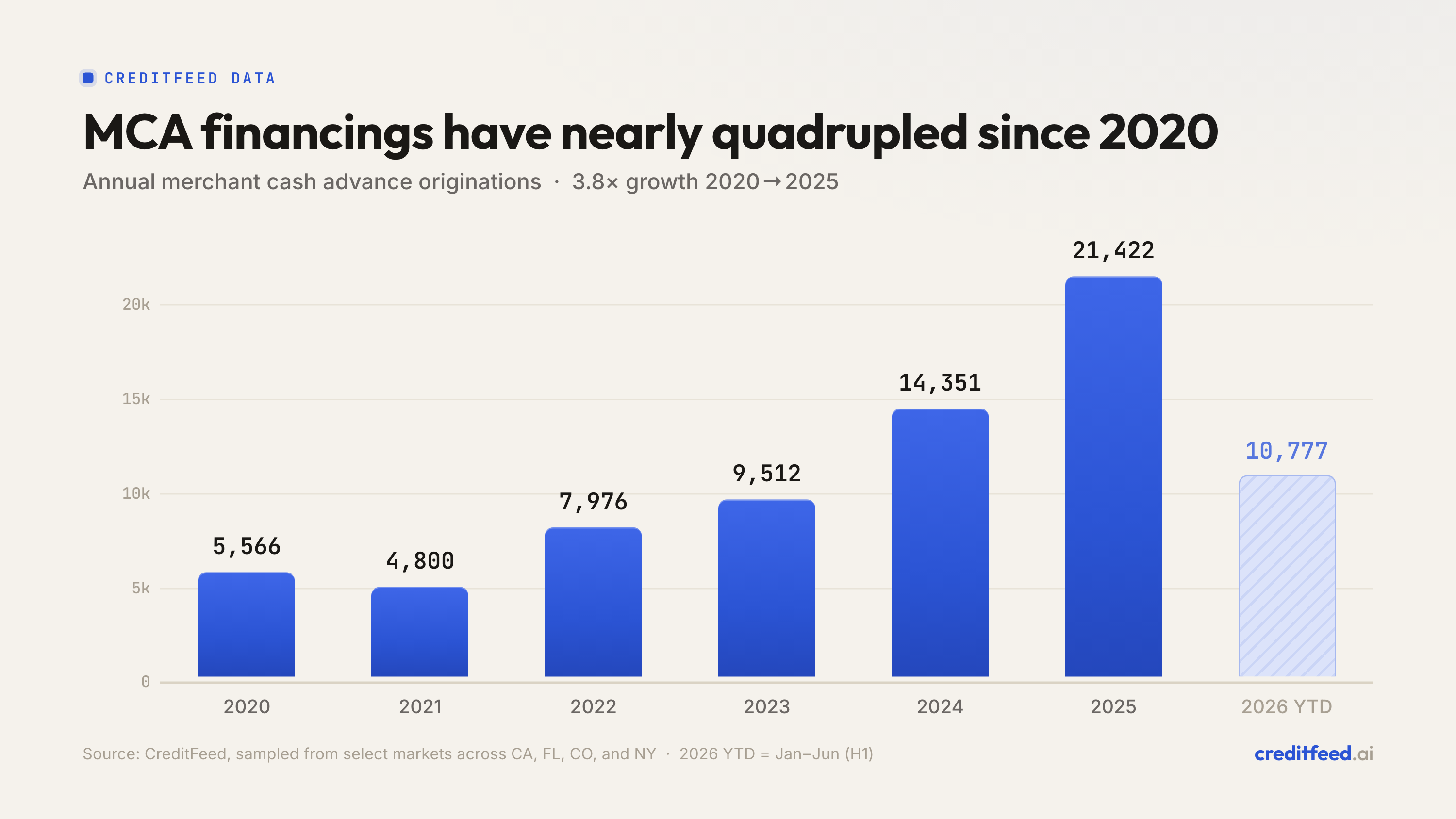
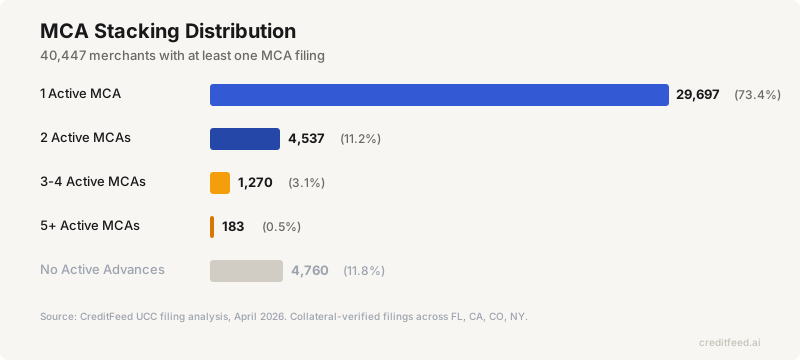
MCA Originations Are Up Nearly 5x Since 2021. Here's What's Driving It.
Industry reports measure MCA growth in dollars. We measured it in actual deals. The acceleration is more dramatic than the headlines suggest.
Everyone in the MCA space knows the market is growing. The industry reports say it. The conference panels repeat it.
- Precedence Research values the global MCA market at $20.7B in 2025, projecting $41.8B by 2035 (7.3% CAGR).
- The Small Business Finance Association estimated that U.S. MCA and small business lending volume exceeded $20B annually as of 2023.
- Federal Reserve research on nonbank lending found that alternative lending volume has grown over 400% since 2010, with MCA among the fastest-expanding categories.
But these numbers describe dollars deployed. They don't tell you how many deals are actually closing, who's funding them, or whether growth is accelerating or plateauing.
So we went to the source. Every merchant cash advance requires a UCC-1 filing. It's the legal fingerprint of an MCA deal. We pulled every MCA origination filing across multiple representative states from 2019 through Q1 2026 and extrapolated nationally.
The growth is not gradual. It's a hockey stick.
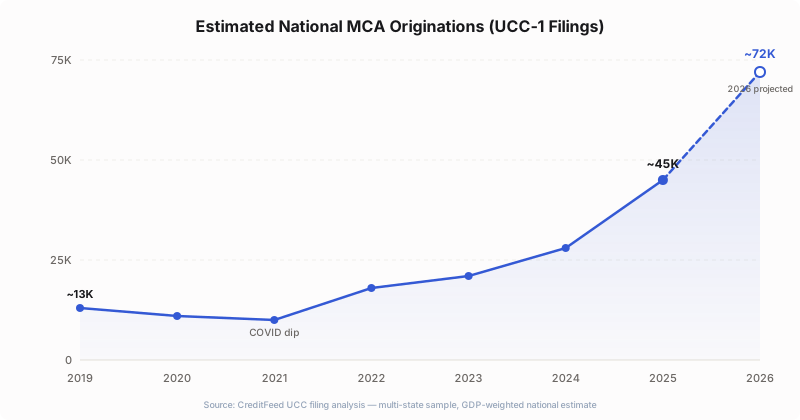
Nearly 5x Growth Since 2021. And Accelerating.
Estimated national MCA origination filings by year:
| Year | Est. National MCA Originations | YoY Change |
|---|---|---|
| 2019 | ~13,000 | — |
| 2020 | ~11,000 | -17% |
| 2021 | ~10,000 | -7% |
| 2022 | ~18,000 | +79% |
| 2023 | ~21,000 | +17% |
| 2024 | ~28,000 | +31% |
| 2025 | ~45,000 | +60% |
| 2026 (proj.) | ~72,000 | ~+60% |
COVID created a brief dip: 17% down in 2020, another 7% in 2021, bottoming at roughly 10,000 originations nationally. But recovery was explosive. +79% in 2022 alone, blowing past pre-pandemic levels. Since then, growth has reaccelerated every year: +17%, +31%, +60%. From the 2021 trough to 2025, that's nearly 5x.
This pattern is consistent across every state in our sample. Diverse economies, different lender mixes, different starting points. Same trajectory. MCA is also gaining share: from roughly 0.6% of all credit originations in 2021 to over 2% by 2025 and 5% in Q1 2026.
Q1 2026 is already at ~18,000 originations nationally. Annualized, that's ~72,000. If the recent acceleration holds, the number could be higher. No deceleration in sight.
Who's Stepping In to Meet the Demand?
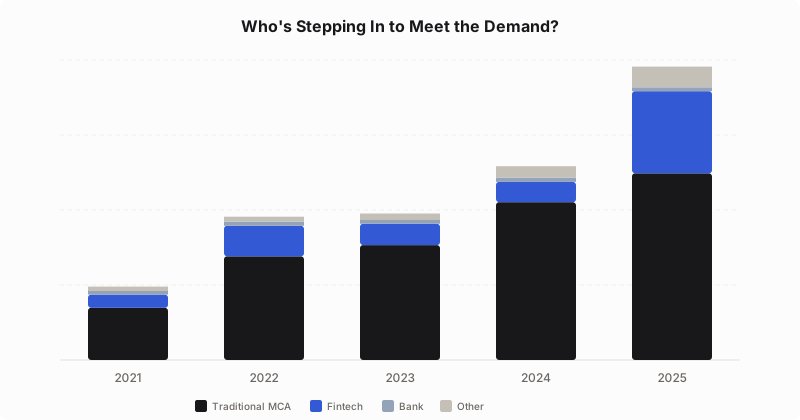
Not banks
Banks account for less than 1% of MCA filings. And they're shrinking. Bank-originated MCA volume has actually declined since 2019 while the overall market grew nearly 5x. MCA is entirely an alternative lending product. If you're using bank-focused credit databases to find MCA prospects, you're looking in the wrong place.
Traditional MCA lenders are growing, in absolute terms
The black bars in the chart tell one story: traditional MCA shops are scaling. CFG Merchant Solutions (Credibly) roughly doubled origination volume since 2023. Bitty Advance grew nearly 30x in two years. Overall, traditional MCA lender volume has nearly quadrupled since 2021.
But fintechs are taking share. Fast.
Look at the blue. Fintech share of MCA originations has more than doubled, from 12% to 28%. The 2025 surge is striking. Fiserv (First Data Merchant Services) grew over 12x in two years. Parafin, the company powering Shopify Capital, went from zero to a significant share in the same period.
And those are just the fintechs visible in UCC filings. The real number is almost certainly higher. Square originated $5.7 billion in business loans in 2024, making them the largest online business lender tracked by deBanked. Yet they barely register in public UCC filing data. They've now originated over $32 billion since 2014 and updated their AI underwriting to reach 250,000 previously ineligible merchants. Shopify Capital, Stripe Capital, and other embedded lending products work the same way. Billions in merchant advances, largely invisible in public filings.
Why are fintechs winning? They own the payment relationship. They don't need brokers, lead lists, or cold calls. They see merchant revenue data in real time and extend capital automatically. Captive merchant bases. Real-time transaction data. AI underwriting. These are structural advantages traditional lenders can't replicate with manual processes.
And they reach merchants who are both reachable and ready. Square doesn't cold-call a list of 100,000 businesses hoping 8% pick up. They see a merchant's revenue dip in real time and offer capital before the merchant even thinks to look for it.
The Good News: There's Plenty of Market to Go Around
This isn't a zero-sum game. MCA originations are up nearly 5x since 2021, and the global MCA market is projected to double from $20.7 billion to $41.8 billion by 2035. The pie is getting dramatically bigger. There is more than enough demand for traditional lenders, brokers, and fintechs.
But volume of outreach isn't the game anymore. Timing is. Square uses AI to approve loans on a merchant's first transaction. Shopify lends to sellers who never asked for capital. Stripe offers working capital to businesses already on their platform. Different approaches, same principle: find businesses that are both reachable and ready.
We wrote about this framework in detail: Why 92% of Your MCA Leads Are Dead on Arrival breaks down why most lead lists are waste (wrong contact, dead business, bad number) and how thinking in terms of Reachable × Ready changes the math entirely.
Brokers don't need to become fintechs. They need the same core advantage: seeing which businesses just took capital, knowing which lenders are actively funding, and reaching prospects while they're still in a buying window.
That's what CreditFeed is built for. We monitor UCC filings across state portals and surface the businesses taking MCA funding, the lenders scaling up, and the deals closing. As they happen. Every lead is verified reachable. Every signal tells you who's ready right now.
Methodology
This analysis is based on UCC filing data sourced directly from secretary of state portals. MCA originations are identified by the collateral type "future receivables" in UCC-1 origination filings, the standard industry proxy for merchant cash advances. National estimates are derived using GDP-weighted extrapolation. These estimates are intentionally conservative. Actual national volume may be higher.
Track the market as it moves.
Fresh UCC filings. Lender intelligence. Intent signals. Updated weekly.
Try for free →